
Organoids bring a new dimension to tissue research and engineering
Miniature “organs-in-a-dishâ€� are giving researchers at the Ó³»´«Ã½ and elsewhere unprecedented opportunities to connect genetics with complex biology in a lab setting.

For much of the last 60 years, cell culture has evolved little, in that the basic format that one sees in labs around the world has remained largely the same. Collect tissue or cells. Mix with nutrient media and incubate in a vessel (e.g., a plate, a flask) until you have the number of cells you need. Run your experiment. Repeat.
It is a format that, through millions of experiments, has served science well. But despite the immense knowledge two-dimensional cell culture has taught us about the basics of cell biology and human disease, we could learn more by adding a new dimension.
This is where organoids — minuscule three-dimensional cultured tissue structures that mimic organs’ physical organization — are poised to make an impact.
 A section of a three month-old brain organoid grown from human cells, stained to reveal its structural complexity and variety of cell types. (Credit: Arlotta laboratory)
The making of a mini-organ
“Organoid� typically refers to a self-assembled 3D culture grown from developmentally immature progenitor cells, such as embryonic stem (ES) or induced pluripotent stem cells (iPS, generated by taking cells, usually skin cells, from an individual and chemically reprogramming them into a developmentally younger, stem cell-like state).
Researchers then gently coax the ES or iPS cells to differentiate into the tissue of interest (e.g., brain, gut, pancreas, kidney) using cocktails of signaling chemicals, creating mini-organs that can closely resemble structural features of their real-world counterparts — the brain’s developing ventricles and the intestines’ crypts and folds, for example. As a result, organoids can also help researchers study human tissues’ environments and functions with greater fidelity than animal models or 2D culture systems provide.
“Organoids recapitulate many aspects of the original organ, but in a dish,â€� said Ó³»´«Ã½ associate member and MIT researcher , who makes gut organoids to , and inflammatory bowel diseases. “And as a bonus, you can control the external environment, modulate genes, and model what are essentially human tissues in a controlled setting. They give us a functional assay that we didn’t have before.â€�
 Nascent brain organoids incubating. (Credit: Arlotta laboratory)
Not everyone uses stem cells as their source material for organoids. Yilmaz uses adult stem cells isolated from intestinal biopsies, for example. And in addition to iPS cells, Ó³»´«Ã½ institute member and MIT bioengineer Sangeeta Bhatia’s laboratory uses mature adult liver cells, generating liver spheroids or aggregates that are quite similar to canonical organoids in many respects.
“There are many liver-tropic infectious diseases that are very human specific,� said , a former Bhatia lab member . “You can’t develop mouse models for them because they don’t infect mouse hepatocytes.�
“We can get uniquely useful data from these liver aggregates because there are many differences between them and cell lines derived from liver tumors,� he continued. “The information we’re going to get is going to be much more reflective of what really happens in people, which means we are more likely to find novel and relevant biology.�
 A Yilmaz lab member races to process intestinal biopsies for cells for seeding organoids. (Credit: Yilmaz laboratory)
Opening up the accessible
Organoids derived from iPS cells have an additional advantage: they contain any molecular lesions present in the donor’s heritable germline DNA (for instance, mutations linked to neurodegenerative disorders). Thus, with a patient-derived organoid scientists can peer into processes that might be otherwise inaccessible, such as those within a developing brain, or learn how genetic variations revealed in genome-wide association studies actually contribute to disease.
Take psychiatric disorders. Their genetics tell us that each person’s genetic make-up affects how disease-linked mutations manifest clinically—indicating that such effects can only be studied in human brain cells derived from patients (and control individuals), according to Ó³»´«Ã½ institute member and Harvard neuroscientist Paola Arlotta. Plus, the human brain differs greatly from that of commonly used animal models, and neuropsychiatric disease affects parts of the human brain that in other species are underdeveloped.
 A cerebral organoid up close. (Credit: Arlotta laboratory)
“We just don’t know enough about what goes on in the brain of a schizophrenic patient, electrically or chemically,� said Arlotta, who uses brain organoids . “While much work is still needed to recapitulate with fidelity the formation of brain structures in a dish, “there will be components of these systems that can be reproducibly made and those might be the cells and circuits affected in diseases of interest.�
A tool, but not a panacea
That is not to say that organoids are the right model for all experiments. �There are pros and cons to working in 3D or 2D,� Ramanan said. “When we decide which model systems to use, it’s mostly dependent on the questions we’re trying to ask. We want to build in only as much complexity as needed and have the model systems provide easy readouts for the assays we want.�
 (L) A human gut organoid (pink) transplanted within a mouse intestine. (R) Intestinal organoids stained with mitochondrial and nuclear markers. (Credit: Yilmaz laboratory)
So what are the key applications for organoids and similar 3D culture systems? At the moment they hold the greatest promise for studies related to:
-
Drug development (giving researchers an early read on a compound’s effects and toxicities in a near-human system)
-
Neurodevelopment and disorders of the brain (where the processes that fuel a condition cannot be directly observed in humans because they take place early in development or are physically locked away in inaccessible tissue)
-
Stem cell and regenerative biology (capturing early events in differentiation and organ development or regeneration)
-
Cancer (providing a window into the impacts of different risk factors and modeling early steps in tumor development)
-
Tissue engineering (moving potentially, one day, toward transplantation)
 3D liver aggregates grown from rat hepatocytes (purple cells) seeded atop fibroblasts (green). (Credit: Bhatia laboratory)
Growing a field
As organoid research matures, scientists are trying to generate more complex organoids, ones that incorporate more than one cell type and which reflect the interactions that go on within an organ system more accurately.
“I think the future of gut organoid research is really about convergence, about trying to understand how the microbiome, the stroma, the epithelium, and the immune cells all work together,� Yilmaz explained, noting that he already adds immune and neural cells to some of his intestinal organoids, and wants to try adding gut microbiota as well. “It’s the only way to see through the noise.�
For some systems, though, nature’s complexity may be too great to mimic in a dish. “The brain is much more complex than simply a bunch of nerve cells,� Arlotta said, adding that astrocytes, oligodendrocytes, microglia, and other cell types all support and interact with neurons in particular ways, creating a complex environment that may never be fully replicated in the lab. “There are so many subtleties about how the brain is built and what the brain is.�
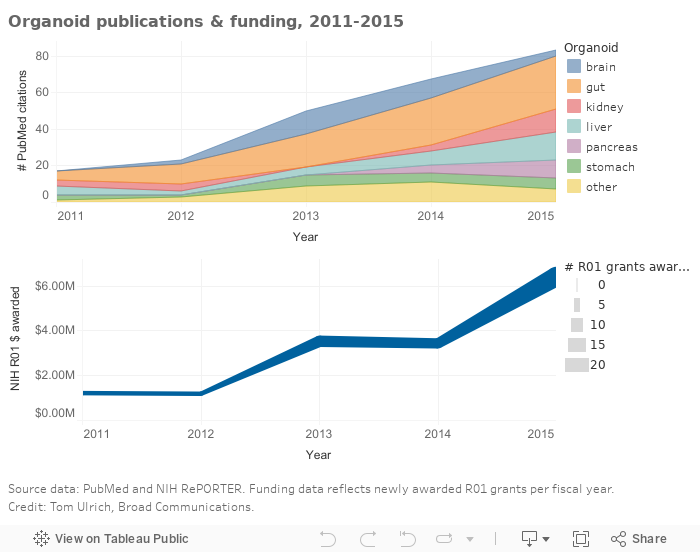
Seeds of growth. While the number of publications reporting organoid-based research remains small, it is trending upward. So too is the amount of funding the NIH is putting toward organoid work.
When you mix all of the questions about complexity, source material, culture systems, and research together, one theme consistently stands out: Relevance.
“The big picture for the field is that in order to really understand the relevant human biology,� Ramanan said, “you want to have the right types of cells in your systems, which means getting as close to human primary cells and environments as possible. Organoids provide multiple routes to doing that, whether you’re starting with patient-derived stem cells or primary adult cells.�
“We’ve learned a tremendous amount of biology from 2D cell lines, and will continue to do so,� Yilmaz said, mulling organoids’ future place in research. “But I think that in the next 10 years there’s going to be a pretty dramatic shift to organoid-based assays.�
With reporting contributed by Angela Page.


